


Home / Air Cooling Solutions / Diecast Heatsink
Air Cooling
Die Cast Heatsink
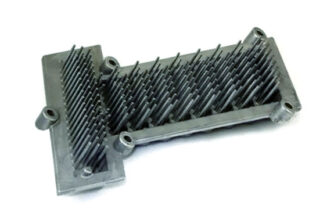
What is a Diecast Heatsink?
Diecasting is a casting process where molten metal is forced into a molded cavity under high pressure. The intricate detail of the heatsink profile is mirrored on the molded profile of the cavity. Once the molten metal has cooled the die mold is opened and the completed heatsink removed. Due to the high temperatures and pressures involved the die must be manufactured from hardened tool steel which represents a high capital cost and tends to limit the process to high volume applications.
Radian utilizes a hot-chamber die casting process where a pool of molten metal is fed into the die via a pneumatic or hydraulic piston. This system has the advantage of fast cycle times (approximately 15 cycles a minute). Radian diecast heatsinks are primarily manufactured using aluminum based alloys (356.0, A380).
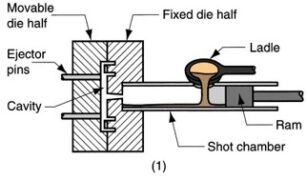
Manufacture of Diecast Heatsink
The Diecast process utilises a die made up of two halves. One half is called the “cover die half” and the other is called the “ejector die half”. A parting line is created on the part where the two die halves meet. The die is designed so that the finished casting will slide off the cover half of the die and remain in the ejector half as the die is opened. The ejector half contains ejector pins to push the casting out of the ejector die half. In order to prevent damage to the casting, an ejector pin plate accurately drives all of the pins out of the ejector die at the same time and with the same force. The ejector pin plate also retracts the pins after ejecting the casting to prepare for the next shot.
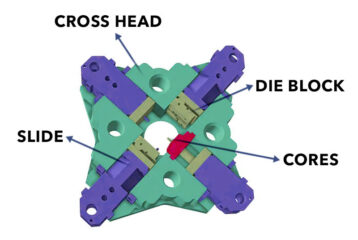
Excess metal known as “flash” is the thin rib of excess metal that appears at the parting line, around ejector pins, or near slides when molten alloy leaks past an imperfectly sealed die cavity. Careful die design at the early stages can reduce cost by minimising flash. Multi-slide casting machines allow very complex designs with additional costs. For more information on the casting process we would recommend the following:
Radian can also provide rapid prototyping for a diecast heatsink using the same alloy without hard tooling which allows for addition changes to the mold.
Diecast heatsink casting process
The following are the typical steps in Radian’s die casting process:
- Create the die mold
- Lubricate the Die
- Fill the die with molten metal
- Ejection from the cover die half
- Shakeout from the ejector die half
- Trimming and then grinding the excess material
- Powder coat, paint, or anodize the diecast heatsink
Diecast heatsink material
| Dicast Material | Thermal Conductivity W (mK) | Density (g/cc) | Melting Point (°C) | Ultimate Tensile Strength (MPa) |
|---|---|---|---|---|
| A380 | 109 | 2.76 | 238 – 593 | ≥324 |
| A356.0 | 151 | 2.68 | 557.2 – 612.8 | ≥207 |
The higher the content of aluminium in a diecast part the higher the thermal conductivity, improving the thermal performance of the heatsink. Aluminum can be difficult to die cast, so impurities are often added to aid in the die casting process which reduce the thermal conductivity. A 380 is the most commonly used diecast aluminium grade due to its improved strength compared to A 356.0. Radian use A 356.0 due to its improved thermal conductivity of 151 W/(mK) which is close to the extruded or machined levels of 160-200 W/(mK). It should be noted that the reduction in Ultimate Tensile Strength for A 356.0 is not generally a problem for most heatsink applications.
Diecasting is ideal for high volume applications that can offset the initial Non-recurring engineering (NRE) cost of a complex heatsink design.Typically at around 5,000 pieces the initial NRE is covered by the reduced part cost. Diecasting in high volume has the advantage of reduced manufacturing times, part cost and the ability to produce complex geometry compared to machining and other similar processes.