


Home / Liquid Cooling Systems / Liquid Cold Plates
Liquid Cooling
Liquid Cold Plates
What are Cold Plates?
Cold plates are specialized heat exchangers designed to transfer heat away from critical components, maintaining optimal operating temperatures. They typically consist of a solid metal plate with fluid channels integrated into their structure. The primary function of a cold plate is to absorb heat from a source—such as a semiconductor device—and transfer it to a coolant, usually liquid or a specialized refrigerant, which then carries the heat away from the system.
Cold plates are essential components in thermal management systems, particularly for applications requiring efficient heat dissipation. They play a critical role in various industries, including electronics, aerospace, automotive, photonics and renewable energy. As devices become more powerful and compact, the need for effective cooling strategies has surged, making cold plates a focal point in thermal management technologies.
Design and Materials
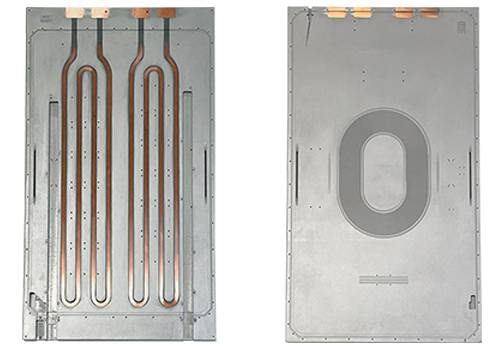
The design of cold plate liquid cooling systems can vary significantly based on their application and the specific thermal management requirements. The most common materials used for custom liquid cold plates include aluminum and copper, chosen for their excellent thermal conductivity. Aluminum is lightweight and cost-effective, making it suitable for many applications, while copper offers superior thermal performance, albeit at a higher cost and weight. Custom liquid cold plates can be designed using various methods, including:
- Machined Cold Plates – These are made by machining solid blocks of metal to create channels. This method allows for precise control over the channel geometry, facilitating optimized heat transfer.
- Bonded Cold Plates – These are made using either Friction Stir Welding or Diffusion Bonding where two similar or dissimilar metals are permanently joined together without liquid fusion, filler metals, or loss of weight. The two united metals can be of varying thicknesses but, once joined, still retain their initial strength and temperature resistance.
Working Principle
The operation of a cold plate is relatively straightforward. Heat generated by a component is transferred to the cold plate, where it is absorbed by the metal. The coolant, which flows through the channels, carries this heat away from the cold plate. The efficiency of this heat transfer process is influenced by several factors, including the flow rate of the coolant, the temperature differential between the coolant and the heat source, and the design of the cold plate itself.
Liquid Cold Plates Applications
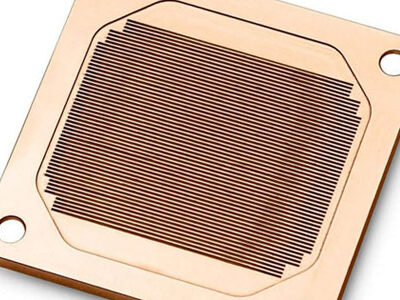
Electronics: In the electronics industry, liquid cold plates are widely used to cool power electronics, CPUs, and GPUs. As devices become more powerful, effective cooling solutions such as cold plates are essential to prevent overheating and ensure reliability.

Aerospace: Cold plates are critical in aerospace applications, where they help manage the thermal loads of avionics and power systems in aircraft. The lightweight nature of aluminum cold plates is especially advantageous in this sector.
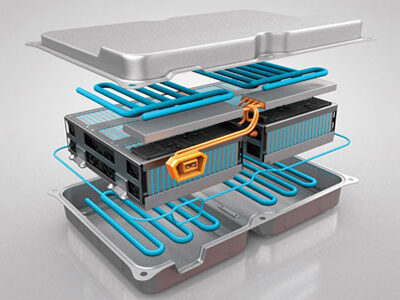
Automotive: With the rise of electric vehicles (EVs), cold plate cooling plays a crucial role in battery thermal management. They help maintain optimal temperatures in battery packs, enhancing performance and longevity.

Renewable Energy: In solar power systems and other renewable energy technologies, cold plates are used to manage heat in inverters and other components, ensuring efficient operation.
Advantages of Cold Plate Cooling:
- High Efficiency: Cold plates offer a highly efficient means of heat removal, essential in applications where space is limited, and heat generation is high.
- Customization: They can be tailored to specific applications, allowing for optimized thermal performance based on the heat load and environmental conditions.
- Reliability: Cold plates are generally robust and can operate in harsh environments, making them suitable for critical applications.
- Cost-Effectiveness: When compared to other cooling methods, such as air cooling or traditional heat sinks, cold plates can offer better thermal performance at a competitive cost, particularly in high-power applications.
Challenges and Future Trends
Despite their advantages, liquid cold plates face challenges, including potential thermal interface material (TIM) issues, which can impede heat transfer if not properly managed. Additionally, the design and manufacturing of cold plates must consider factors such as fluid flow dynamics and thermal cycling to ensure long-term reliability.
Looking ahead, advancements in materials science and manufacturing techniques promise to enhance the performance of cold plates. Innovations such as microchannel designs and phase change materials (PCMs) could provide even greater efficiency in heat transfer. Integration with smart technology and sensors may also facilitate real-time monitoring and adaptive cooling strategies.
Liquid Cold Plates Solutions By Radian
Friction Welded Liquid Cold Plate
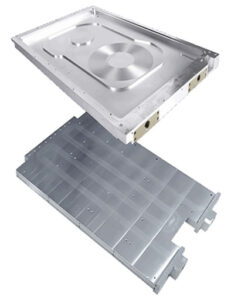
Friction Stir Welded (FSW) liquid cold plates are manufactured using advanced solid-state welding technology to create strong, leak-free cooling solutions with exceptional thermal performance. Produced from high-conductivity materials such as aluminum and copper, these cold plates provide efficient heat transfer while maintaining excellent structural integrity and reliability under demanding operating conditions.
FSW liquid cold plates are widely used to cool high-power electronic devices across industries including aerospace, automotive, telecommunications, defence, and industrial power systems. The friction stir welding process enables complex internal cooling channel designs that maximize coolant flow and improve heat dissipation without compromising strength. This makes FSW liquid cold plates an ideal solution for cooling semiconductors, power electronics, battery systems, and other heat-sensitive components where efficient thermal management is critical to performance, reliability, and product longevity.
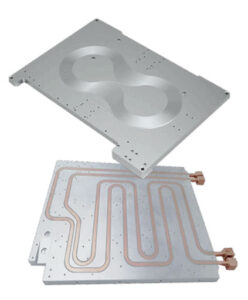
Copper Tube Liquid Cooled Plate
Copper tube liquid cold plates are engineered to deliver reliable and efficient thermal management by transferring heat from high-load surfaces directly into a circulating liquid coolant. By embedding precision-formed copper tubing within an aluminum or copper base, these cold plates provide excellent thermal conductivity while offering a cost-effective and durable cooling solution for a wide range of applications.
Designed to handle high heat loads and continuous operation, copper tube liquid cold plates are commonly used in military, medical, automotive, telecommunications, renewable energy, and industrial electronics applications. They are particularly well suited for cooling power converters, inverters, power supplies, laser systems, and other high-power electronic assemblies. Their robust construction, dependable performance, and flexible design options make them an excellent choice for applications requiring efficient heat removal, long service life, and dependable operation in demanding environments.
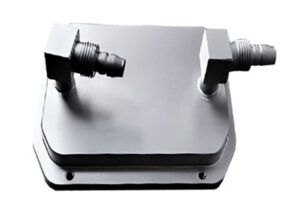
Brazed Liquid Cold Plate
Brazed liquid cold plates are often made of materials like aluminum or copper. They efficiently transfer heat from high-load surfaces to the broader liquid cooling system, ensuring high-performance thermal management.
Brazed liquid cold plates are widely used in power electronics, telecommunications, medical devices, transportation, renewable energy, and industrial automation. Their ability to dissipate high heat loads while maintaining stable operating temperatures improves equipment performance, enhances reliability, and extends the service life of sensitive electronic components. Available in various configurations, they can also be customized to meet specific thermal, mechanical, and packaging requirements.
Design Capability - Vacuum Brazed Cooling Plate 1
- Product Features: High-Pressure Serpentine Design – The serpentine narrow channel design, combined with vacuum brazed sealing, enables the product to handle high coolant pressure. The channels can withstand pressures of 3 MPa or higher without compromising the performance or dimensions of the cold plate. Due to the small bending radius of the serpentine channels, the flow path can flexibly extend to almost any position on the cold plate while avoiding interference with threaded holes.
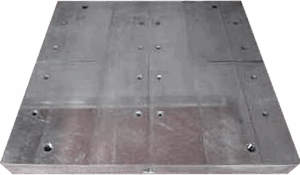
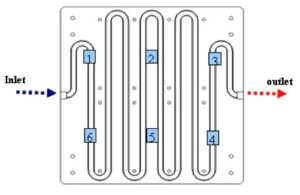
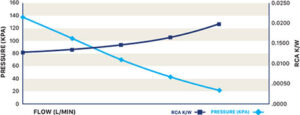
Outer dimension: 320 x 300 x 20mm. Heat source area: 200 x 143mm x 2pcs. Cooling Capacity: 3,082W
| Item | Power (W) | Flow (L/min) | Tin ℃ | T1 C | T2 ℃ | T3 ℃ | T4 ℃ | T5 ℃ | T6 ℃ | Rca (℃/W) | Pressure (Kpa) |
|---|---|---|---|---|---|---|---|---|---|---|---|
| 1 | 1541 | 12 | 28.3 | 39.5 | 43.2 | 47.8 | 42.4 | 43.5 | 44.8 | 0.0127 | N/A |
| 2 | 1541 | 10 | 28.4 | 40.6 | 44.8 | 49.2 | 42.7 | 44.1 | 46.8 | 0.0135 | N/A |
| 3 | 1541 | 8 | 28.6 | 41.8 | 46.1 | 50.9 | 44.7 | 45.2 | 475 | 0.0145 | 70 |
| 4 | 1541 | 6 | 28.2 | 43.3 | 48.0 | 53.6 | 469 | 47.2 | 49.5 | 0.0165 | 43.46 |
| 5 | 1541 | 4 | 28.2 | 46.6 | 51.9 | 58.6 | 52.3 | 51.0 | 53.4 | 0.0197 | 21.2 |
Design Capability - Vacuum Brazed Cooling Plate 2
- Product Features: Optimized Flow Channel Design – The flow channels are optimized according to the location of the heat source. By widening the channels and increasing the number of cooling fins where heat is concentrated, heat dissipation performance is improved and flow resistance within the cold plate is significantly reduced.
- Product Features: High-Pressure Sealing – Vacuum brazed sealing is used for this product, providing the channels with excellent pressure resistance.
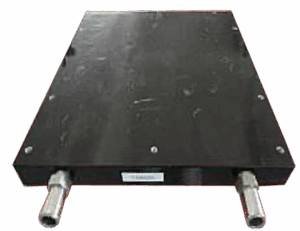
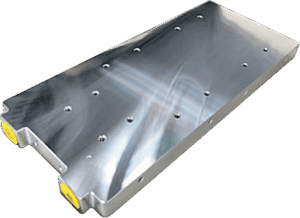
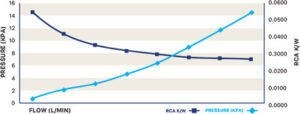
Outer dimension: 230 x 190 x 22mm. Heat source area: 63 x 137mm x 3 pcs. Cooling Capacity: 900 W
| Item | Power (W) | Flow (L/min) | Tin ℃ | T1 C | T2 ℃ | T3 ℃ | T4 ℃ | T5 ℃ | T6 ℃ | Rca (℃/W) | Pressure (Kpa) |
|---|---|---|---|---|---|---|---|---|---|---|---|
| 1 | 300 | 2 | 28.5 | 37.4 | 38.7 | 42.1 | 43.2 | 44.8 | 41.9 | 0.0543 | 0.8 |
| 2 | 300 | 3 | 29.3 | 36.5 | 37.2 | 39.3 | 40.6 | 41.7 | 38.9 | 00413 | 2.13 |
| 3 | 300 | 4 | 30.0 | 35.8 | 36.6 | 38.3 | 39.5 | 40.3 | 37.6 | 0.0343 | 3.07 |
| 4 | 300 | 5 | 29.6 | 35.5 | 35.6 | 37.1 | 38.7 | 39.9 | 36.5 | 0.0343 | 4.67 |
| 5 | 300 | 6 | 29.6 | 35.7 | 35.6 | 37.0 | 38.6 | 38.8 | 36.3 | 0.0307 | 6.4 |
| 6 | 300 | 7 | 30.0 | 35.3 | 35.2 | 36.5 | 38.2 | 38.1 | 35.9 | 0.0273 | 8.93 |
| 7 | 300 | 8 | 29.8 | 34.5 | 34.5 | 36.1 | 37.8 | 37.8 | 35.3 | 0.0267 | 11.72 |
| 8 | 300 | 9 | 29.8 | 34.8 | 34.9 | 36.1 | 37.6 | 37.7 | 35.3 | 0.0263 | 14.48 |
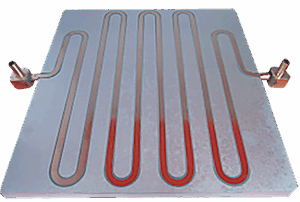
Design Capability - High Contact Epoxy Bonded Copper Tubing
- Product Features: Superior Corrosion Resistance – Copper offers excellent corrosion resistance, making it ideal for long-term cooling applications.
- Product Features: Material Compatibility Considerations – For optimal performance, it is best to avoid using different types of metal components together in cooling systems (for example, an aluminum cold plate with a copper radiator), as the potential difference between metals can cause electrochemical corrosion.
- Product Features: Design Flexibility – For certain applications, liquid cold plates with pressed copper tubes are the preferred choice. Copper tubes have excellent flexibility and can be bent or formed under pressure, allowing for versatile design configurations.
- Product Features: Hybrid Construction Options – When properly designed to minimize galvanic corrosion, copper tubes can be combined with aluminum base plates to provide both design flexibility and cost-effective manufacturing of liquid cold plates.
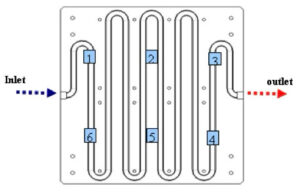
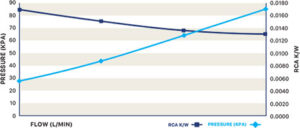
| Item | Power (W) | Flow (L/min) | Tin ℃ | T1 C | T2 ℃ | T3 ℃ | T4 ℃ | T5 ℃ | T6 ℃ | Rca (℃/W) | Pressure (Kpa) |
|---|---|---|---|---|---|---|---|---|---|---|---|
| 1 | 1837.5 | 4 | 36.4 | 64.60 | 67.50 | 66.8 | 60.50 | 62.50 | 63.2 | 0.0169 | 27.93 |
| 2 | 1837.5 | 6 | 35.7 | 59.80 | 63.40 | 61.2 | 58.60 | 60.90 | 61.9 | 0.0151 | 43.89 |
| 3 | 1837.5 | 8 | 36 | 57.60 | 61.10 | 57.9 | 55.50 | 55.90 | 54.5 | 0.0137 | 64.39 |
| 4 | 1837.5 | 10 | 35.5 | 56.5 | 59.6 | 56.1 | 53.2 | 53.1 | 53.5 | 0.0131 | 85.64 |
Conclusion
Liquid cold plates are a cornerstone of modern thermal management technology, addressing the increasing demands for efficient heat dissipation in various industries. As technology continues to evolve, so too will the designs and applications of cold plates, leading to even greater efficiencies and expanded use in new fields. Their ability to maintain optimal operating temperatures is crucial for the reliability and performance of high-power systems, making them an indispensable component in today’s thermal management landscape.
Radian Thermal products specializes in custom liquid cold plates tailored for a variety of applications. Call us for more information.