


Home / Air Cooling Solutions / Extruded Heatsink
Air Cooling
Extruded Heatsink
What is an Extruded Heatsink?
An extruded heatsink uses the extrusion manufacturing process where material (either hot or cold) is pushed through a die of the desired cross-section at high pressure. A good video of the extrusion process can be found at this link. An extruded heatsink can have very complex cross-sections, and due to the high force and elevated temperature used to create the extrusion, facilitates the use of materials with otherwise brittle properties. The extrusion process forms parts with an excellent surface finish, is ideal for additional surface treatments such as Anodizing, or Plating. Radian utilises its experience using the “gummy” and difficult to work aluminum alloy A6063 to manufacture highly thermal conductive (200 W/(mK)) heatsinks. Extruded heatsinks are suitable for high volume production with a relatively low NRE. The molds are typically made with an EDM wire machine, and the Tooling lead time is typically 4-6 weeks. The extrusion process is most cost effective when post machining is not required, as additional CNC machining may induce stress in the part causing misshape. The effects of post machining can be minimised by special thermal treatment to limit failures due to stress. Extruded heatsinks can be manufactured as high fin density, thin fined heatsinks for forced air applications or thicker fin, low fin density for natural convection environments.

Plate-Fin Extruded Heatsink
One of the most common type of extruded heatsink is the plate-fin extruded heatsink. An extruded plate-fin heatsink uses straight fins that run the entire length to maximize the surface area of the heatsink. The heatsink can have additional machining to create a cross-cut which has a similar effect to an elliptical-fin heatsink.
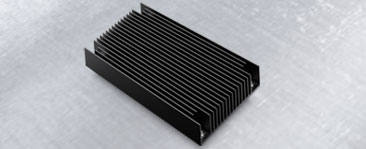
Standard Extruded Heatsink
The following list of standard extruded heatsinks are usually available within a few days. These heatsinks are extruded, cut, post machined and then black anodized. As these standard extruded heatsinks have already been tooled, we can customize by increasing or reducing the length of the heatsink.
In addition, an extruded heatsink can have a fan added to create an active cooled heatsink.
High-Performance Extruded Aluminum Heatsink Solutions
Managing thermal dissipation in high-power electronics requires a balance of high thermal efficiency, manufacturing precision, and cost-effectiveness. A custom or standard aluminum extruded heatsink serves as the backbone for robust B2B thermal management, offering an optimal path for heat transfer in both natural convection and forced-air environments. Radian leverages advanced extrusion capabilities to deliver rugged cooling components that meet strict engineering specifications across the medical, energy, aerospace, defense and telecommunications industries.
Why choose an extruded aluminum heatsink?
Aluminum extruded heatsinks provide significant advantages in design flexibility and structural integrity compared to stamped-fin alternatives. Utilizing premium aluminum alloys like A6063, our extrusion process allows for high aspect ratio fin geometries that drastically maximize surface area within a compact footprint. This makes it an ideal solution for cooling high density components.
From an operational standpoint, opting for an extruded heatsink minimizes initial overhead. The process features exceptionally low Non-Recurring Engineering (NRE) costs and rapid tooling fabrication via precision EDM wire cutting. This allows engineering teams to move seamlessly from prototyping to high-volume production without the prohibitive lead times or capital investments tied to other manufacturing methods. These profiles easily accommodate CNC machining tasks for mounting holes, interface padding, and specialized anodized finishes to improve both thermal radiation and corrosion resistance.
Optimizing thermal conductivity with aluminum extruded heatsinks
Whether your system architecture demands standard profiles or complex, application-specific cross-sections, Radian’s engineering team ensures your aluminum extruded heatsink is optimized for maximum thermal conductivity. By integrating these targeted thermal profiles into your electronic system, you ensure long-term component reliability while minimizing thermal throttling, and reducing cost of ownership. Partner with Radian to scale your thermal capabilities with precision-engineered extrusion technology.
| Part | Type | Style | Material | Length (mm) | Width (mm) | Height (mm) | Theta SA (°C/W) at 200LFM | Theta SA (°C/W) at 400LFM | Theta SA (°C/W) at 600LFM | Part |
|---|---|---|---|---|---|---|---|---|---|---|
| HS1568EB | Pushpin | Platefin | Aluminum | 57.9 | 36.8 | 11.4 | 2.2 | 1.3 | 1 | View |
| HS1574EB | Pushpin | Platefin | Aluminum | 57.9 | 36.8 | 22.9 | 0.9 | 0.6 | 0.5 | View |
| HS1576EB | DCDC | Platefin | Aluminum | 61 | 57.9 | 11.4 | 1.4 | 0.8 | 0.6 | View |
| HS1579EB | Pushpin | Platefin | Aluminum | 61 | 57.9 | 5.8 | 2.7 | 1.7 | 1.3 | View |
| HS1592EB | DCDC | Platefin | Aluminum | 116.8 | 61 | 11.4 | 1.2 | 0.7 | 0.5 | View |
| HS1594EB | DCDC | Platefin | Aluminum | 116.8 | 61 | 22.9 | 0.7 | 0.4 | 0.3 | View |