


Home / Air Cooling Solutions / Skived Heatsink
Air Cooling
Skived Heatsink
Custom Skived Heatsinks for High-Performance Thermal Management
Radian Thermal Products is a manufacturer of copper and aluminum skived heatsinks for demanding thermal management applications requiring high fin density, thin fins and efficient heat dissipation. Our skiving capabilities combine advanced U.S. manufacturing in Santa Clara, California with an established manufacturing network that includes ISO 9001:2015-certified operations in Asia.
Radian can support the development and manufacture of skived heatsinks with complex fin geometries, high aspect ratios and application-specific machining requirements.

What is a Skived Heatsink?
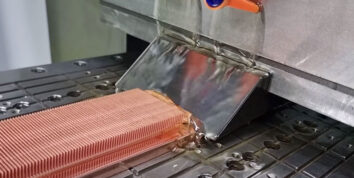
A skived heatsink, also called a skived fin heatsink, is manufactured by cutting thin layers of material from a solid block of copper or aluminum and raising them to form the cooling fins.
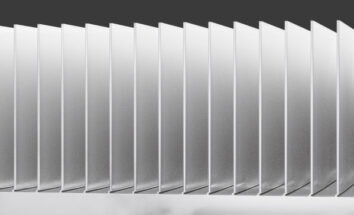
The skiving process allows manufacturers to produce thin, closely spaced fins and high-aspect-ratio geometries that can be difficult or impractical to achieve with conventional manufacturing methods. Because the fins and base are formed from the same piece of metal, a skived heatsink has a continuous thermal path from the base into the fins.
Skived heatsinks are well suited for applications requiring:
- High fin density
- Thin cooling fins
- High-aspect-ratio fin configurations
- Large heat-dissipating surface area
- Copper or aluminum construction
- Custom dimensions and geometries
- Prototype or production quantities
How is a Skived Heatsink Manufactured?
Skiving uses a precision cutting tool to remove thin layers of material from a solid block of copper or aluminum. As the tool moves through the material, each layer is raised to create an individual cooling fin.
The basic manufacturing process includes:
- Material selection: Copper or aluminum is selected according to the thermal, mechanical and weight requirements of the application.
- Material preparation: The starting material is prepared to the required overall dimensions.
- Skiving: A precision cutting tool removes thin layers from the material to form the fins.
- Fin formation: The fins are raised and formed into the required height, thickness and spacing.
- Secondary machining: Mounting holes, slots, surfaces and other features can be machined as required.
- Inspection: The completed heatsink is inspected against the applicable design and quality requirements.
Radian’s published capabilities include skived fins as thin as 0.008 inches, depending on the material and design.
How to Identify a Skived Heatsink?
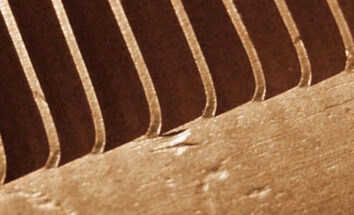
It is fairly easy to identify a Skived heatsink as the heatsink has a curve where the blade finishes its cut at the base of the heatsink, as shown in the image.
In addition, the fins are not completely vertical, and curve slightly, which is more pronounced as the fins get taller.
The typical width of a Skived heatsink base is 200 mm, but it is possible to manufacture up to 400 mm wide heatsinks by rotating the block of material and running a second pass with the curvature of the fins in the opposite direction.
As a Skived heatsink is manufactured from a long block of material, the only real limit to the length of the heatsink is the length of the block. Different heights can be achieved by machining the block of material. Any excess material is recycled to reduce wastage. Typical finishes for aluminum skived heatsinks are anodization or nickel plating. Typical finishes for copper Skived heatsinks are anti-oxidant or nickel plating.
Skived Heatsink Manufacturing in the U.S. and Asia
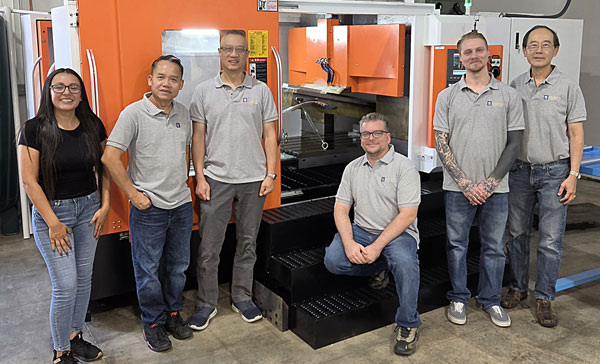
Radian Thermal Products recently expanded its U.S. manufacturing capabilities with the addition of a new skiving machine at its Santa Clara, California machine shop. This top-tier skiving machine provides increased capacity with a working table of 1,700 × 800 mm and support for fin heights of up to 60 mm in copper and 150 mm in aluminum. This additional production capability allows Radian to address an increasing demand in high-performance thermal solutions.
Radian’s skived heatsink manufacturing capabilities also extend to its ISO 9001:2015-certified manufacturing operations in Asia. This expanded manufacturing network provides additional capacity to support prototype development, production launch and ongoing manufacturing programs.
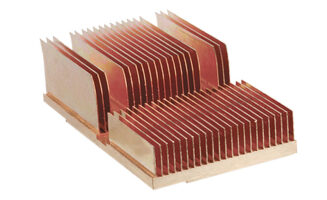

Skived Heatsink Example
In this example a copper skived heatsink was manufactured to create two sets of fins with different heights. Some of the taller fins were removed, and additional machining operations were added to accommodate other components in the assembly. Originally the customer was using a CNC machine to make the copper heatsink. By making a few changes to the heatsink drawing, they were able to utilize a higher performing heatsink with lower manufacturing costs.
In this example, the customer had an issue where additional software programming caused the chip to create more heat. This incident occurred close to product release. A replacement heatsink was required to have the same form factor as the original heatsink and fit on the board using the same push pin hole locations. A copper skived heatsink was quickly manufactured, and additional machining operations created a modified base to allow this higher performing heatsink to replace the older design.
Benefits of Skived Heatsinks
- High-density fins: Skiving allows thin, closely spaced fins to be produced, increasing the available heat-dissipating surface area within a defined heatsink footprint.
- One-piece construction: The fins and base are formed from the same piece of material, eliminating a separate bonded, soldered or mechanically attached fin-to-base interface.
- Thin fin geometry: Radian can produce skived fins as thin as 0.008 inches, depending on the material and design requirements.
- High-aspect-ratio designs: Skiving is well suited to fin configurations where increased fin height and surface area are required within a limited footprint.
- Minimal setup requirements: Compared with processes requiring dedicated tooling, skiving requires minimal setup, making it well suited to custom heatsink designs, prototypes and certain production requirements.
Copper vs. Aluminum Skived Heatsinks
Whether a cooper or an aluminum skived heatsink is the better solution depends on the thermal, mechanical, weight and cost requirements of the application.
Copper skived heatsinks: Copper provides high thermal conductivity and can be an effective choice when heat must be transferred efficiently from a high-power component into a dense fin structure. Radian manufactures copper skived heatsinks using CU1100 copper, among other material options appropriate to the application.
Aluminum skived heatsinks: Aluminum provides a lightweight alternative to copper and can be appropriate when weight, thermal performance and cost all need to be considered. Radian’s skiving capabilities include aluminum, providing additional flexibility when selecting the material for a custom heatsink.
Skived Heatsink Applications
Skived heatsinks are used in electronic and thermal management applications where high surface area and efficient heat dissipation are required. Potential applications include:
- Power electronics
- Semiconductor cooling
- Industrial electronics
- Telecommunications equipment
- High-power electronic assemblies
- LED and lighting systems
- Computing and electronic equipment
- Forced-air thermal management
The appropriate heatsink geometry depends on factors including component heat load, available airflow, allowable temperature and available space.
FAQs About Skived Heatsinks
How thin can skived heatsink fins be?
Radian can produced as thin as 0.008 inches, depending on the material and design requirements.
Are copper skived heatsinks available?
Yes, Radian manufactures custom copper skived heatsinks, including designs using CU1100 copper.
Are aluminum skived heatsinks available?
Yes. Radian’s skiving capabilities include aluminum, providing a lightweight alternative to copper for appropriate applications.
What is the difference between a skived and extruded heatsink?
A skived heatsink has fins cut directly from the base material, while an extruded heatsink is formed by forcing material through a die. Skiving can provide greater flexibility for thin, high-density fin configurations, while extrusion can be advantageous for high-volume production of established profiles.
Does Radian manufacture skived heatsinks in the United States?
Yes. Radian has advanced skiving capabilities at its Santa Clara, California machine shop. Radian also has established skiving capabilities within its ISO 9001:2015-certified global manufacturing network.
Can Radian support prototype and production quantities?
Yes. Radian’s U.S. and global manufacturing capabilities allow the company to support development, prototyping and production programs according to project requirements.
Request a Custom Skived Heatsink
Radian Thermal Products can help evaluate your thermal requirements and develop a skived heatsink designed around your application. Send us your drawing, existing heatsink design, thermal specifications or application requirements and our engineering team can determine the required material, fin configuration, manufacturing process and production approach.