What is Computational Fluid Dynamics (CFD)?
In modern thermal management, testing thermal behavior through physical prototypes alone is no longer viable. Computational Fluid Dynamics (CFD) analysis provides a sophisticated virtual environment to simulate fluid flow, heat transfer, and thermodynamic forces within electronic systems. By utilizing advanced mathematics and physics models, thermal engineering teams can predict precisely how airflow or liquid coolants interact with solid components. This predictive capability ensures that critical hardware operates within safe thermal limits before a single physical component is manufactured.
How Does CFD Simulation Work?
- Preprocessing: The 3D CAD geometry of the cooling system is imported, and the fluid domain is defined. The volume is then divided into a continuous geometric mesh consisting of millions of tiny cells.
- Boundary Conditions: Engineers input real-world variables, including material properties, volumetric flow rates, fluid inlet temperatures, and component heat loads.
- Solving: High-powered processing units solve the Navier-Stokes equations across every cell in the mesh to track fluid velocity, pressure, and temperature.
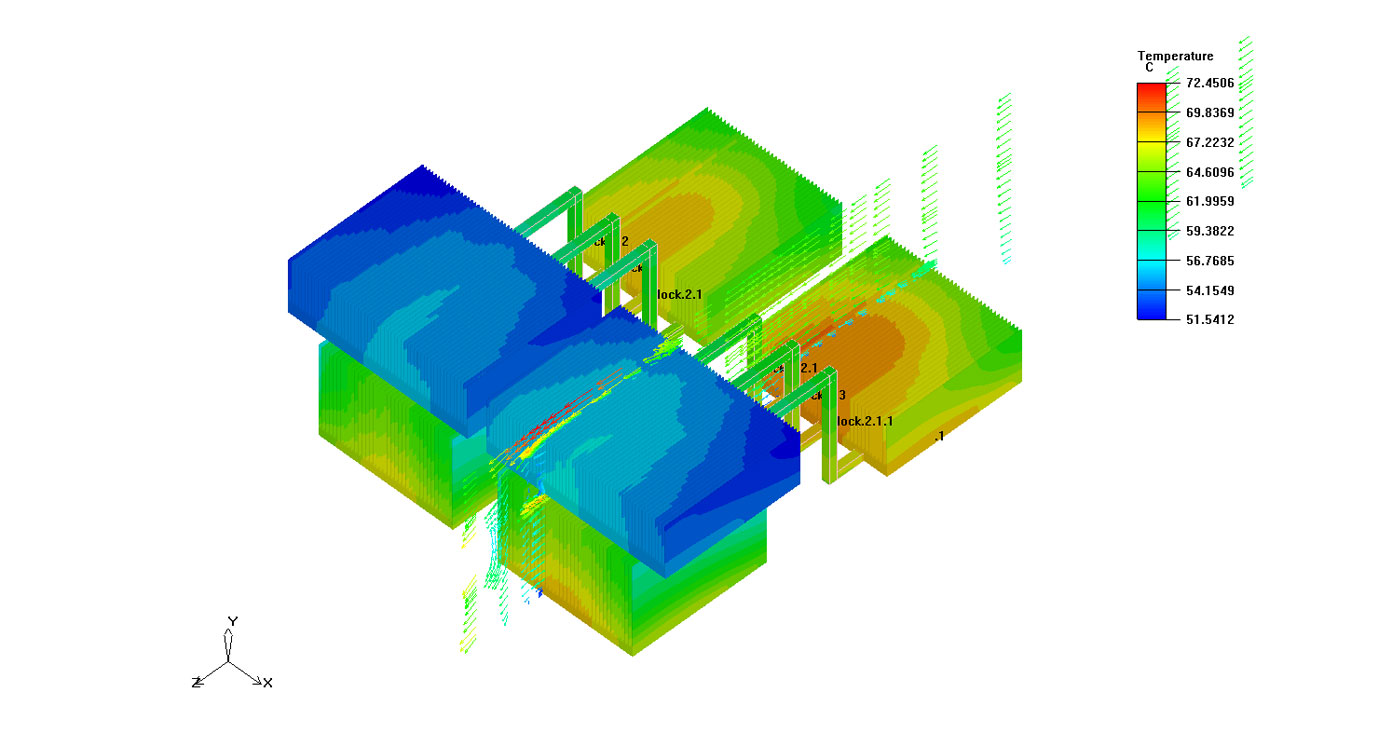
- Post-processing: The software generates visual flow trajectories, contour plots, and thermal maps. This allows design optimization to occur rapidly by identifying stagnation zones or restrictive fluid bottlenecks before initiating the manufacturing process.
Importance of CFD in Thermal Engineering
A Few Industrial Applications for CFD Thermal Analysis
Aerospace systems require absolute reliability under extreme environmental variations. CFD thermal analysis is used to design cabin climate systems, optimize avionics enclosure cooling, and simulate the intense thermal management needed for propulsion systems and high-altitude electronics.
Data Centers and Artificial Intelligence (AI)
The massive power demands of next-generation central processing units (CPUs), graphics processing units (GPUs), and AI clusters produce unprecedented thermal loads. CFD simulation is essential for architectural airflow modeling, hot/cold aisle containment design, and validating direct-to-chip liquid cooling systems. It ensures data centers optimize their Power Usage Effectiveness (PUE) and prevent thermal throttling across high-density server racks.
Energy Sector
From traditional power plants to renewable infrastructure, CFD is indispensable. It optimizes the cooling loops of large-scale power transformers, simulates wind turbine aerodynamic efficiencies, and manages the critical thermal regulation profiles required for utility-scale battery energy storage systems (BESS).