Skived vs Extruded Heatsink: Choosing the Right Manufacturing Process
Because Radian Thermal Products designs and manufactures both profiles natively, our engineering team provides an objective look at how these two distinct fabrication methods perform under real-world system constraints. Understanding the mechanical boundaries of each process allows design teams to maximize thermal efficiency while keeping production costs firmly in check.
Understanding the Structural Differences
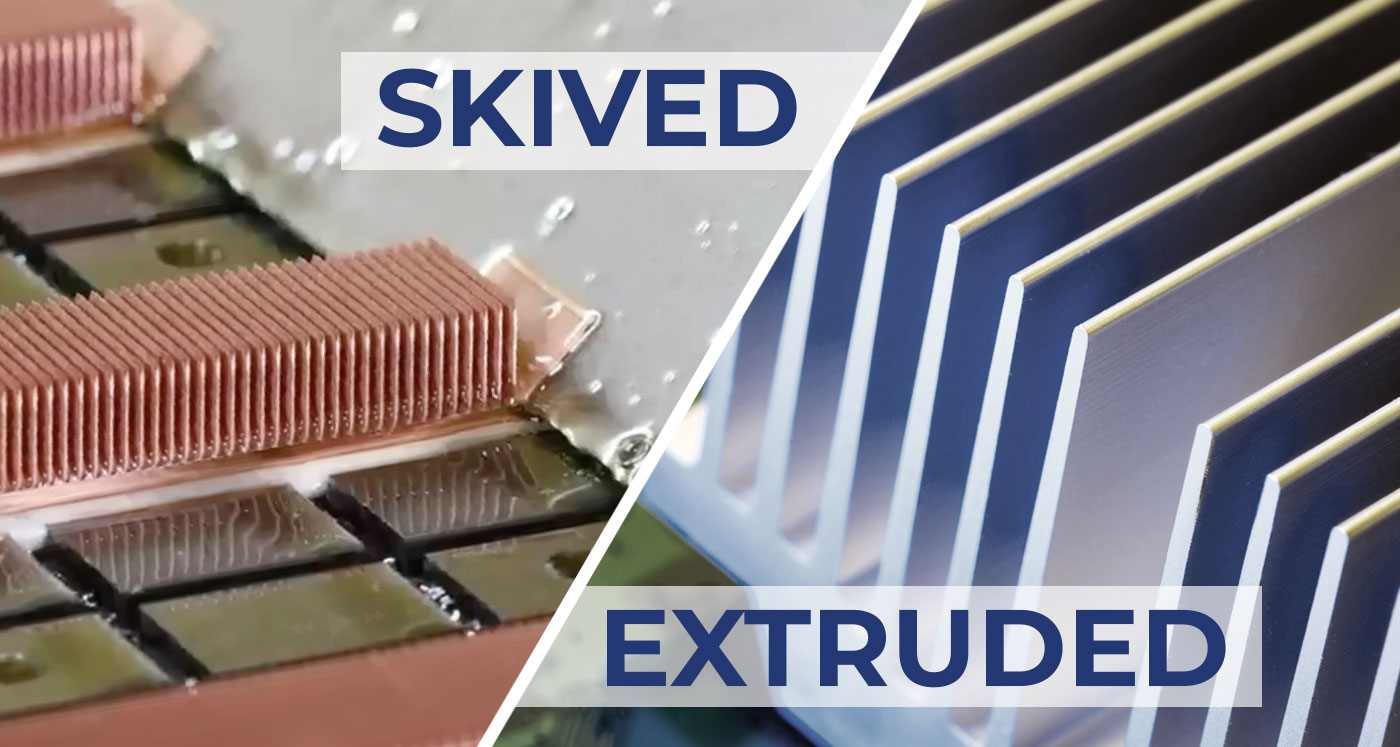
- The extrusion process involves heating raw aluminum alloy billets and forcing them through a tool steel die under immense pressure. This creates a highly uniform, continuous linear profile where the base and fins form a singular, monolithic piece of metal.
- The skiving process utilizes a precise, heavy-duty carving blade to slice ultra-thin fins directly from a solid block of raw copper or aluminum. As the blade shaves each millimeter of material, it mechanically bends the fin upright at a right angle to the base. Because the fins are peeled away from the parent metal block, there is no bonded interface between the base and fins. This provides a continuous thermal path through the parent material, ensuring a continuous path for localized heat dissipation.
Thermal Performance: Fin Density and Material Limits
Skived fin heatsinks break past these geometry limitations. The shaving process allows for high aspect ratio fins that are significantly thinner and packed much tighter together than what an extrusion die can physically support. This massively increases the total available surface area within a highly compact geometric footprint.
Furthermore, skiving allows engineers to utilize pure copper. Extruding copper is incredibly difficult and accelerates tool wear, meaning almost all extruded heatsinks rely on aluminum alloys like A6063. Skiving bypasses this metallurgical constraint completely, allowing high-power electronics to benefit from the superior thermal conductivity of pure copper.
Tooling Costs and Prototyping Timelines
- Extrusion Manufacturing Economics: Extruded profiles feature low to moderate initial NRE costs, primarily tied to the design and precision cutting of the tool steel die via EDM wire processes. Once the die is validated, the per-part cost drops drastically, making extrusion the gold standard for high-volume production runs. However, fabricating and tuning a custom extrusion die typically introduces a lead time of several weeks, which can slow down early-stage engineering validation cycles.
- Skiving Prototyping Versatility: Skiving requires minimal initial setup fees because the process relies on programmable CNC machinery and linear slicing blades rather than custom-molded tooling. This makes skived components ideal for rapid prototyping, low-volume production, or agile engineering phases where fin geometries may need to shift between design iterations. Without the burden of die fabrication, lead times are compressed significantly, allowing teams to source functional prototypes almost immediately.